The underground garage went silent before anyone moved. Six Harley-Davidson engines shut down at the exact same second, and in the ringing quiet that followed, a grown man took a slow step backward. He had walked into that concrete cavern, expecting shadows and exhaust, and men who minded their own business. Instead, he found six pairs of eyes that had seen war, had buried friends, had held dying strangers on the side of dark highways, and had long since stopped fearing consequences. Behind the largest of those men, pressed into the crease of a worn leather vest, a barefoot 7-year-old girl in a yellow dress was shaking so badly her teeth chattered.
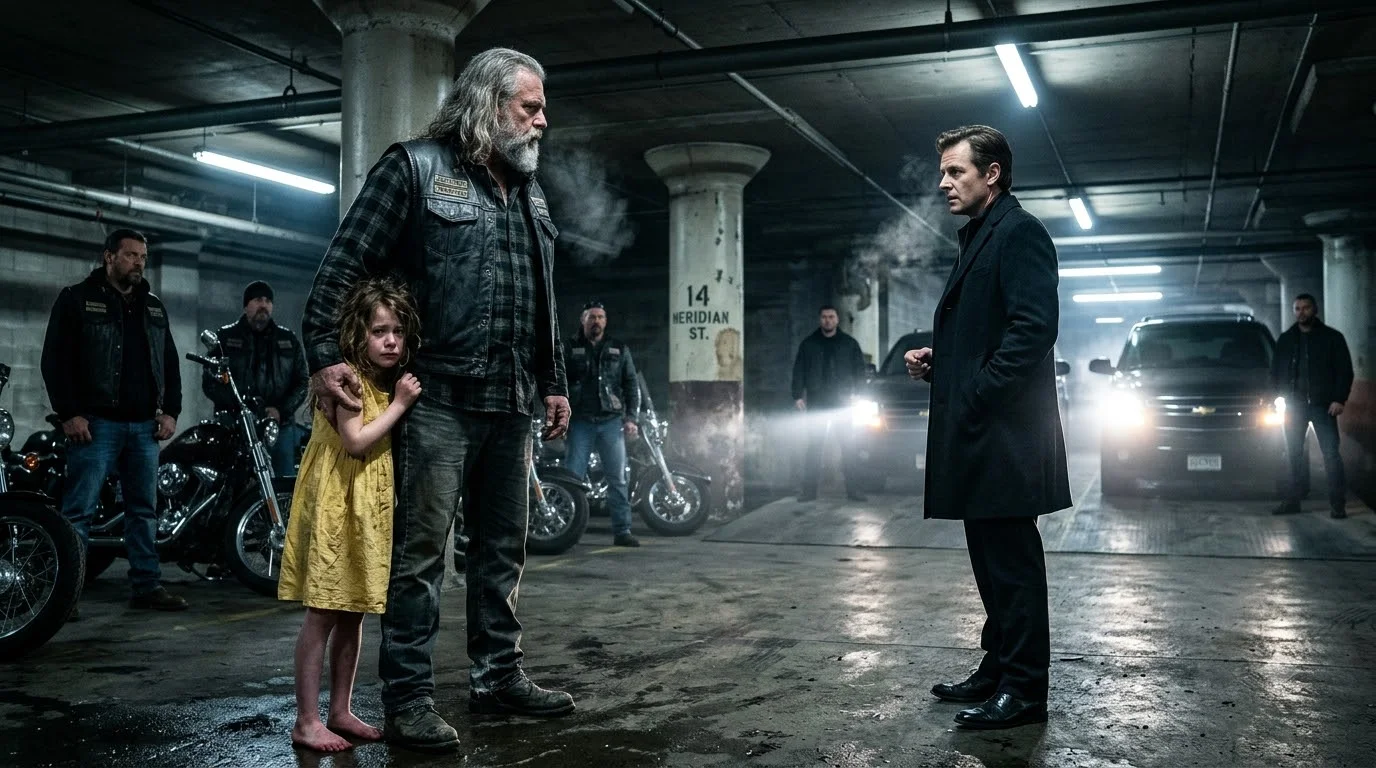
She didn’t scream. She didn’t run. She simply wrapped two small fists into the back of that vest and pressed her forehead against the iron hard spine of a man she had never met before tonight. And she trusted him completely because she had nowhere else left to go. The Ashen Saints had not planned to be in Harrow Creek that night.
That was the first thing Gideon Mercer would tell Detective Voss 3 days later, sitting in a fluorescent lit interview room with dried blood still creased into the knuckles of his left hand and a cold cup of coffee he hadn’t touched. They had not planned any of it. They were passing through six men and six machines and a highway that cut south through 400 m of nothing. A fuel stop, a parking structure that Rook had spotted from the street because the overhead lot was full and it was starting to sleep. That was all.
But Gideon Graves Mercer had learned a long time ago that the worst nights of your life never announced themselves. They just arrived. He was 58 years old and he carried it in every part of his body. The knee that had been rebuilt twice. The two fingers on his right hand that didn’t fully straighten anymore.
The scar that ran from his left ear to his collarbone, smooth and pale as candle wax, which he never explained to anyone. His hair was the color of old iron, and he wore it long enough to curl behind his ears. His beard was the same color. His eyes were a pale, washed out gray that people rarely held for more than a few seconds. Not because they were cold, exactly, but because they were too patient.
The eyes of a man who had seen enough of the world to understand that most crises arrived slowly, disguised as something ordinary, and by the time you recognized them for what they were, you were already inside them. He had been a combat engineer, 13 months in a country that had tried to kill him every single day. He had come home with those eyes and a tremor in his right hand that lasted 3 years and a marriage that lasted 18 months after that. His daughter Maya had been born 6 weeks premature, translucent and furious and impossibly alive. She had lived 22 years.
she had been killed by a drunk driver on a Tuesday morning in February, 4 years ago, on her way to a job interview. She had been so nervous about that she’d called him twice the night before. Graves had not spoken for 11 days after the funeral. The Saints had not pushed him to. That was the thing about this club that people on the outside never understood.
The Ashen Saints were not a gang. They were not an organization in any formal sense that would satisfy a prosecutor or a sociologist. They were six men and at various points in the club’s 12-year history, as many as 17 who had each arrived at the same crossroads separately by different wreckage and found that the only people who didn’t require them to perform normally were the others who had also given up on performing it. Rook was a former marine sniper who hadn’t slept more than four consecutive hours since 2009. Dutch was a paramedic who had worked the night shift in three different cities until the accumulated weight of what he’d seen had simply broken something fundamental in the mechanism of how he processed the world.
Callum was the youngest at 34, the only one who hadn’t served. But he’d grown up with a father whose idea of discipline had put him in the hospital twice before he was 12. And there was a particular kind of damage that did to a person that was indistinguishable in the body from the damage done by shelling or a burning building. They were broken in different shapes. They fit together because of it.
The parking garage at 14 Meridian Street in Harrow Creek was a four-level concrete structure that smelled of motor oil and the particular damp cold of enclosed spaces in early December. The sleet had started thin and dry, rattling against the corrugated metal panels above the entrance ramp like someone dragging a key along a fence. Graves had led them down to the second level, out of the weather, and they had just killed their engines when he heard it. Not a sound exactly, a stillness within a sound. The low, controlled breathing of someone who was trying very hard not to be heard.










