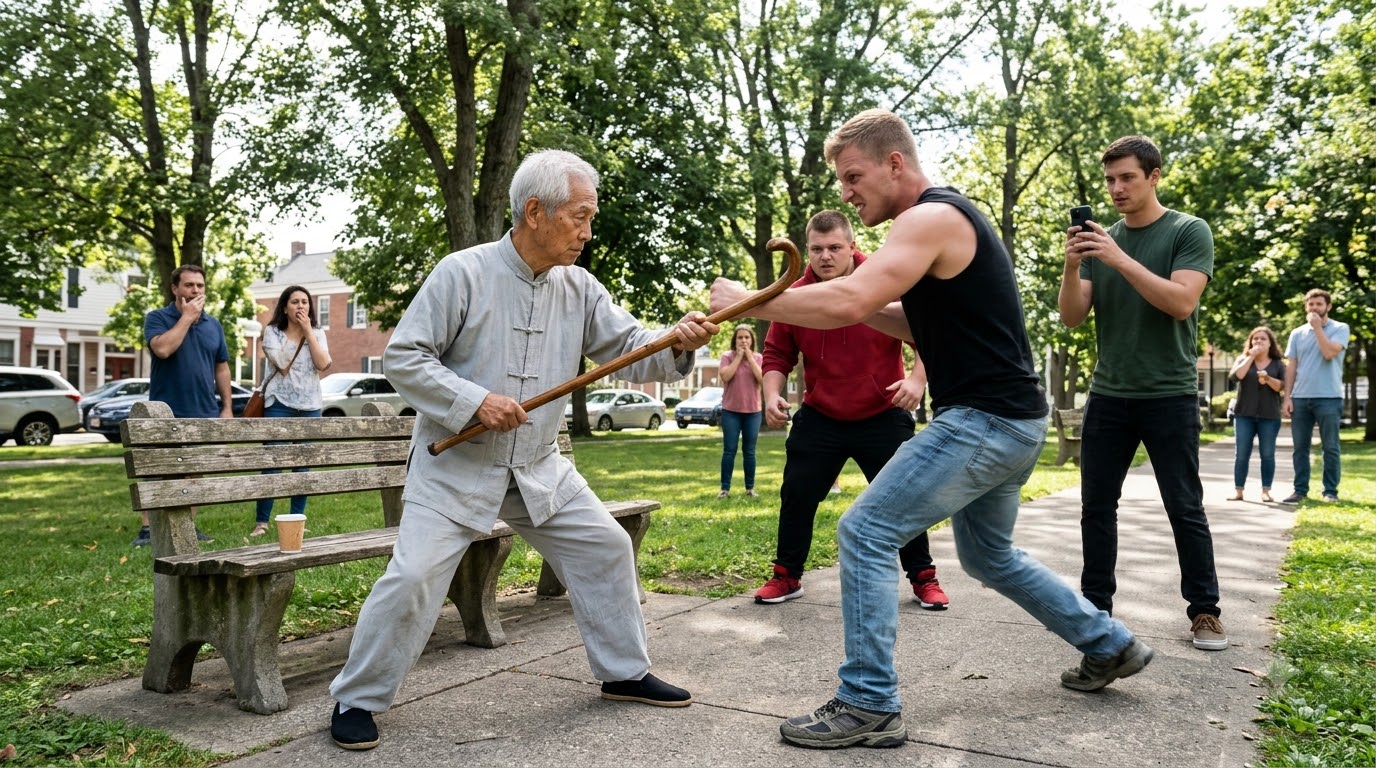
Mr. Kenji Tanaka practiced beneath the plane trees at dawn, wearing loose cotton trousers and a faded cardigan. His cane rested against a bench, and a paper cup of tea steamed beside him. At seventy-eight he knew exactly which joints would complain when the weather changed. He moved anyway, not to impress the dog walkers or the shopkeepers, but because each slow motion reminded him that his body still belonged to him.
There was a difference between the version of the day that strangers would later repeat and the one the people inside it actually lived. In the telling, everything happened quickly and everyone knew what was right. In the moment, there were pauses, doubts, ordinary sounds, and the uneasy knowledge that a single choice could change what came next.
Rick, Taye, and Nolan arrived laughing with a phone already recording. They called him a grandfather doing ballet in pajamas. Tanaka asked them not to disturb the tea. Their laughter grew louder because he had answered without fear.
Tanaka did not believe that a good deed erased the harm that preceded it. He believed in repetition: one morning of patience followed by another, one repaired board followed by another, one honest answer given when a lie would be easier. That belief was not comforting to people who wanted forgiveness to arrive as quickly as an apology. It demanded the slower labor of becoming trustworthy.
For Tanaka, the important part was not the spectacle but what it revealed about the people standing nearby. A person could be surrounded by witnesses and still feel entirely alone. The faces in the crowd carried their own histories, and the old man had become practiced at recognizing the difference between curiosity, amusement, and fear. He refused to confuse any of them with agreement.
The conversation did not end when the last words were spoken. It followed people into kitchens and shopfronts, where they replayed what they had heard and wondered what they might have done differently. Some defended themselves by saying that nothing could have changed. Others began to suspect that this excuse was one of the reasons the same troubles kept returning.
Later, when the immediate noise had faded, the same question returned in a quieter form: what should a person do with the power available to them? Tanaka never claimed that power was harmless. He said only that the responsibility to choose carefully grew greater as a person became more capable.
Tanaka had never believed that age made him immune to mistakes. His knees ached, his shoulder stiffened in the cold, and there were mornings when he missed the people who were no longer alive to share his tea. He had learned to make room for those losses without allowing them to decide every action. When someone mistook his slowness for helplessness, he felt sadness before anger, because he knew how little the stranger understood.
Rick lifted the cane as though it were a toy, then tipped the cup across the pavement. Tanaka watched the tea travel between the cracks and remembered his wife preparing it for him on winter mornings. He said that spilling another person’s tea was rude.
For a long time afterward, the people who witnessed this part of the story remembered details that seemed unimportant at first. They remembered the scrape of shoes, the color of the light, and the silence after a voice stopped speaking. Such details remained because fear made people notice things they usually passed without seeing.
The boys pushed closer, trying to provoke a reaction they could post online. Tanaka remained still until Rick grabbed his sleeve. Then the old man stepped sideways, and Rick discovered how quickly a body could lose its balance.
Rosa understood the practical cost of courage better than anyone who had never kept a small business alive. There were wages to pay, ovens to repair, suppliers who wanted money before delivering flour, and customers who expected the doors to open on time. Fear did not suspend those obligations. It merely made every one of them heavier.
For Rosa, the important part was not the spectacle but what it revealed about the people standing nearby. A person could be surrounded by witnesses and still feel entirely alone. The faces in the crowd carried their own histories, and the old man had become practiced at recognizing the difference between curiosity, amusement, and fear. He refused to confuse any of them with agreement.
The conversation did not end when the last words were spoken. It followed people into kitchens and shopfronts, where they replayed what they had heard and wondered what they might have done differently. Some defended themselves by saying that nothing could have changed. Others began to suspect that this excuse was one of the reasons the same troubles kept returning.










