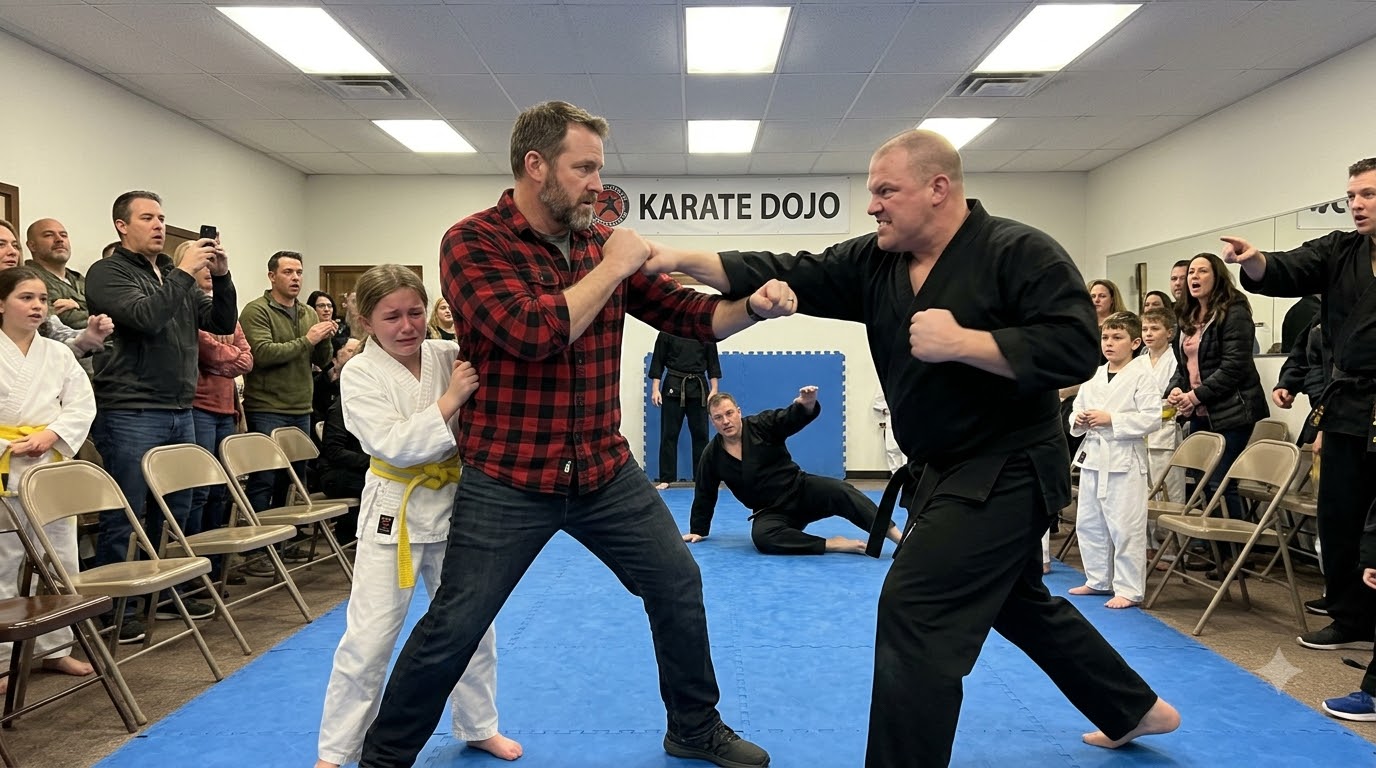
Everyone loves a bully with a black belt until the gym goes dead silent. When a fourth-degree black belt wrapped his forearm around my daughter Chloe’s throat and ignored her frantic taps, a dozen parents froze. He turned to me with a smirk. You got something to say, old man?
What he didn’t know was that I’d spent 14 years leading a Navy SEAL team, and I held a third-degree black belt in Krav Maga. What happened next took exactly one move. In the weeks before that night, I was just a retired Navy SEAL trying to hold together a quiet life as a single father in Colorado Springs. My daughter Chloe was 13, sharp-eyed, quiet, and after a school assault, she needed confidence.
A neighbor recommended Rourke’s Elite Karate. Rourke wore his fourth-degree black belt like a crown and ran every class like a threat. The parents whispered, the assistants nodded, and the kids learned to flinch. The real question wasn’t why he targeted Chloe, it was how far a desperate father would have to go before anyone finally stopped him.
My name isn’t important. What matters is what I carried. For 14 years, I led a Navy SEAL team through places where a wrong twitch got good men buried. I learned one truth above all.
Real violence is quiet, sudden, and over before the loudest man in the room finishes threatening you. That truth had saved my life more times than I could count. After my discharge, I chose Colorado Springs for the mountain silence. My wife had died 3 years earlier, and I was raising Chloe alone.
She was 13 with her mother’s wary green eyes and a quiet stubbornness covered by nervous smiles. She wanted to be a field biologist. She drew insects in the margins of her schoolbooks. Then a boy at school grabbed her backpack and threw her to the concrete for refusing to hand over her phone.
The school called it mutual horseplay. I called it assault. Chloe stopped sleeping. She flinched when car doors slammed.
I knew she didn’t need a weapon. She needed the nerve to occupy her own space. A neighbor recommended Rourke’s Elite Karate. The place sat in a strip mall off Academy Boulevard between a nail salon and a pawn shop.
Inside, the floors gleamed under blue fluorescent tubes. Trophies lined the front desk like little brass soldiers. And in the middle of it all stood Rourke, a fourth-degree black belt, 230 lb of sculpted ego, with an assistant named Dennis who nodded whenever Rourke spoke. From the first class, I sat on the folding chairs with the other parents and watched Rourke teach.
He didn’t correct kids. He publicly dismantled them. A boy named Marcus dropped a stance. Rourke made him hold horse stance until his thighs trembled, then laughed when he fell.
A girl misjudged a block. Rourke slapped the mat and bellowed, “Again. And this time, pretend your life matters.” The kids sweated. The parents snickered or looked at phones.
I sat still. Chloe was no natural athlete. She was narrow and long-limbed, still growing into her own body. On her third class, Rourke paired her with a heavier boy for a forearm escape drill.
He didn’t demonstrate. He just said, “If you don’t get out, maybe you like being held.” Chloe’s face went red. I leaned forward, but she managed to twist free. Rourke folded his arms.
Finally, a pulse. It got worse. Rourke liked kids who adored him. Chloe asked questions.
Once she asked, “Why does the technique work on a taller opponent?” Rourke’s eyes flattened. He called her the little professor, a phrase that curdled into a joke among the assistant instructors. He started using her as the example whenever a technique needed a soft target. Each week, she came home with bruises on her wrists and a new reason to hate class.
I spoke to Rourke once in the parking lot. I said, “You’re hard on her.” Rourke just flashed a smile. “Tough love, Dad. If she can’t handle this, she’ll never handle the real world.” I had spent 14 years in the real world, and I knew the difference between a drill and a beating.
But I told myself to stay patient. Chloe needed this, or at least needed to believe she could fight back. The atmosphere inside the gym was cultish. Parents deferred to Rourke like he was a minor god.
Dennis collected the monthly fees in cash envelopes. A mother near me once whispered, “He’s brutal, but the kids behave.” That was the problem. Everyone registered abuse as discipline. Everyone tolerated it because Rourke had the trophies, the black belt, the confidence of a man who had never been humbled.
I had my own training. 14 years in the teams had taught me close-quarters combat. But after I left the Navy, I studied Krav Maga. The system Israel built for survival, not sport.