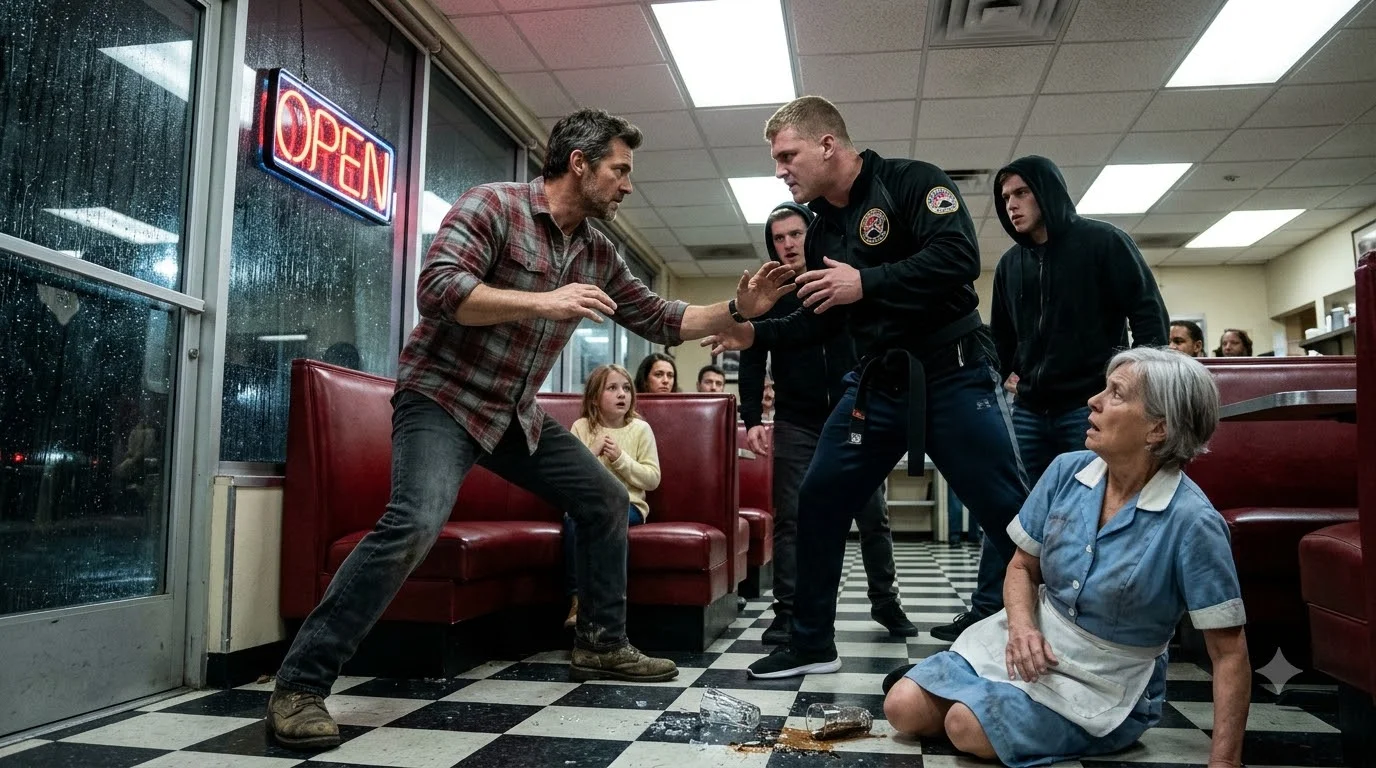
I walked to the edge of the mat, sat on a folding chair, and pulled my flannel back over my head. I put on my socks, laced my boots. Chloe stood by the door, her gym bag clutched to her chest, her neck already bruising. “Dad,” she said.
I stood and put an arm around her. “We’re going home.” But that should have been the end. It wasn’t. By the next morning, someone had posted the video.
Not the full fight, just the last 15 seconds. It showed a quiet father stepping inside a black belt’s punch, dropping him with one elbow and a sweep, then standing over him. The caption read, “Karate instructor chokes teen girl, ex-Navy SEAL dad ends his whole career.” Within 12 hours, it had half a million views. That was the moment the real story started to crack open.
Parents who had stayed silent for years began uploading their own videos. One clip showed Rourke yanking a 10-year-old girl off the mat by her ponytail. Another showed him cranking a boy’s arm until the child screamed, then shouting, “You tapped like a weakling.” A third showed him kneeing a teenager in the ribs during a drill, then looking straight at the nearest parent and saying, “Don’t be soft.” The local news called me. I didn’t answer.
The police called. They said Rourke had filed a complaint claiming I attacked him. But Sarah, the receptionist, gave them the footage from the gym’s own security cameras. It showed everything.
The choke, the frantic taps, the waiver, the fight. They watched it three times. “You didn’t throw the first punch,” the detective said. “He did, and the waiver covers the adult sparring.
But it doesn’t cover what he did to your daughter.” That was when I learned something worse. Rourke was not a fourth-degree black belt. He had been expelled from a national karate association 6 years earlier after injuring a student in Phoenix. He had forged his rank certificate.
The organization had privately warned several dojos about him, but no one had followed up. He moved to Colorado, opened Rourke’s Elite Karate, and built a reputation on trophies no one verified. And it got even bigger. An attorney representing three former students came forward.
Rourke had settled two personal injury claims out of court. The gym’s insurance company had paid nearly $200,000 to make complaints disappear. The parents signed non-disclosure agreements. The local martial arts community knew.
People whispered, but no one had ever made him stop. Why? Because he targeted kids who couldn’t defend themselves, and parents who were too afraid or too impressed to ask questions. He used waivers, charisma, and the silence of eyewitnesses.
Everyone saw the bruises. Everyone looked away. Chloe watched the news coverage from the couch, a blanket around her shoulders. On the third day, she asked me a question I had been dreading.
“Did you like hurting him?” I turned the television off. “No,” I said. “I hated it.” “Then why did you do it?” I sat down beside her. “Because I was the only person in that room who could.
Not because I wanted to. Because I knew if I didn’t, he would do it again.” She was quiet for a long time. Then she said, “I thought Krav Maga was supposed to teach me to defend myself.” “It is,” I said. “But the first lesson isn’t how to hit.
It’s knowing what you’re willing to protect. I was willing to protect you. That doesn’t make violence good. It makes it sometimes necessary.
I don’t know if she fully understood. But that night, she turned off the lamp in her room for the first time in weeks. The fallout continued. Rourke’s Elite Karate was closed by the county within 10 days.
The police charged Rourke with felony child abuse and three counts of assault. His forged rank became national news. The insurance company canceled his policy and opened a fraud investigation. The National Association issued a statement condemning him.
Dozens of former students came forward with stories of emotional abuse, broken bones, and a culture of fear. But here’s the thing nobody expected. The video of me taking him down was not the only reason the gym collapsed. It was the moment that gave people permission to speak.
The parents weren’t just afraid of Rourke. They were afraid of being wrong. If they admitted their child had been abused, they had to admit they had paid for it. They had driven their kids there every week.
They had clapped at belt ceremonies. They had told themselves it was discipline. One mother wrote me a letter. She said, “I knew something was wrong.
I told myself it was tough love. Your daughter was the first one to fight back. I didn’t know how to.” That letter hung on my refrigerator for a month. Rourke’s attorney tried to argue that I had used excessive force.